The book · publishing this year

Silent Revenue Killers

The Everyday Losses Draining Your Profit

Thirteen ordinary patterns quietly draining revenue from companies that look perfectly healthy.

Each one named, each one costed against a real company's numbers, each one with a fix that doesn't require buying anything.

Ask for an early copy
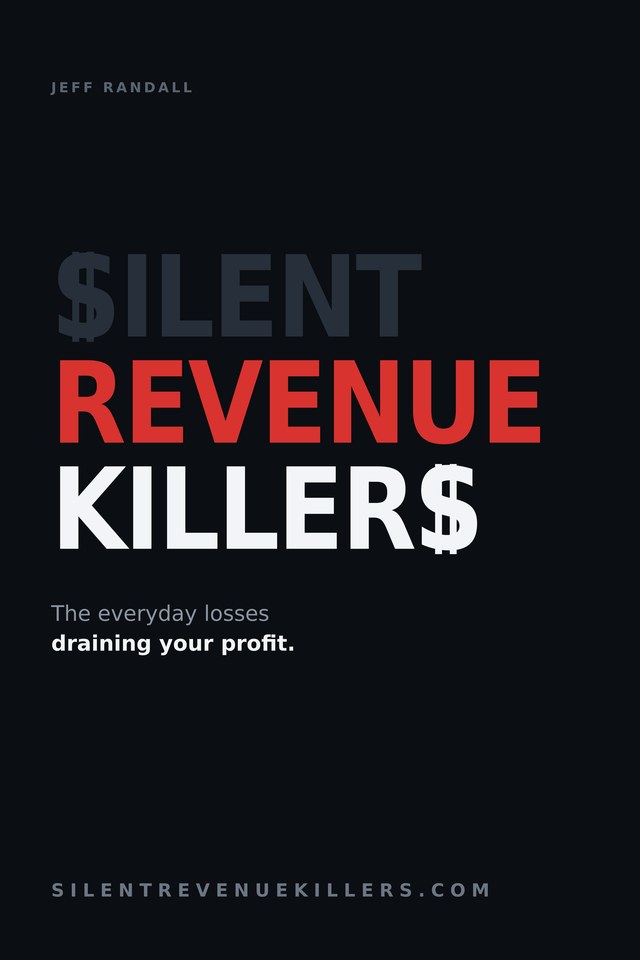
Silent Revenue Killers by Jeff Randall — book cover

"A lot of business books focus on growth strategies and scaling techniques. This book approaches organizations from a different direction. There will probably be moments where parts of it feel familiar in an uncomfortable way. I think that is part of what makes it useful."

Allen Padilla · CEO, The CSU Foundation · from the foreword

The argument

If everyone can see the problem, why does it survive?

Because a small loss spread across twelve months and six departments never produces the day where somebody has to act. Because fixing the visible thing feels like progress and fixing the cause doesn't. And because the cause usually leads back to a decision someone made and would rather not revisit.

These losses don't hide. They sit in plain sight, acknowledged by everyone, and belong to no one.

What's inside

The thirteen.

Not a comprehensive list — every company has its own version of waste and friction. These are the patterns that show up most often, in most places.

01
Fictional PipelinesDecisions made on numbers nobody fully trusts.
02
Reactive FirestormsTime spent on recurring problems instead of the system creating them.
03
Busy Is Not the Same as WorkingInvisible underperformance, and the weight it puts on everyone else.
04
Stolen Productive TimeMeetings, interruptions and admin consuming the hours you pay for.
05
Overlooked TalentGood people screened out before anyone ever meets them.
06
The Path of Least ResistanceBadly built systems quietly teaching people the wrong behavior.
07
Unequal TerritoriesSame quota, completely different work behind it.
08
Customer NeglectRelationships that erode long before anyone churns.
09
Ideas That Never Make ItSignals arriving and dying before they reach a decision.
10
Legacy Processes Nobody QuestionsComplexity mistaken for necessity.
11
The Money Nobody Is WatchingSpend nobody checks, and revenue earned but never collected.
12
Too Busy to ImproveNo capacity left to fix what keeps causing the problems.
13
Unmanaged DiscountingThe price you charge drifting away from the price you think you charge.

How the costs are counted

Four kinds of loss, not one.

Every chapter tells you which kind you're looking at, shows you how to calculate it for your own company, and gives you a fix.

DirectMoney leaving that shouldn't be.
TimeHours consumed producing nothing.
OpportunityWhat didn't get done because the wrong thing ate the day.
CulturalThe hardest to calculate and often the most expensive.

One rule governs every figure in the book: two costs can be added together only if fixing one wouldn't also fix the other.

Why it exists

I kept finding the same things in different companies.

Twenty years on every side of the revenue question — building a company's first sales performance reporting, carrying a number, running an inside sales team, then running the analytics function that told a combined company whether any of its numbers were real.

Every time, someone would ask a straightforward question and it would take days to answer, and the answer would be soft. The money was never hidden. It just wasn't anyone's job to find it.

Certiport · TestOut · CompTIA · co-founder of MetrixGrove

And the practice

The book is where the method came from.

Writing it forced the pattern into an order — what has to be established before anything else can be believed, what can be measured, and what can actually be changed in time to matter.

That order became the way I work with a client. The book isn't marketing for the practice and the practice isn't built around the book. They're one argument: written down, or run on your numbers.

See how the practice works

Next: Silent Wealth Killers — the same idea turned on personal decisions.

Early copies

Ask for a copy before it's out.

I'll send one when it's ready and let you know when it lands. No list, no sequence — just the book and a note.

Or email me directly —
[email protected]